


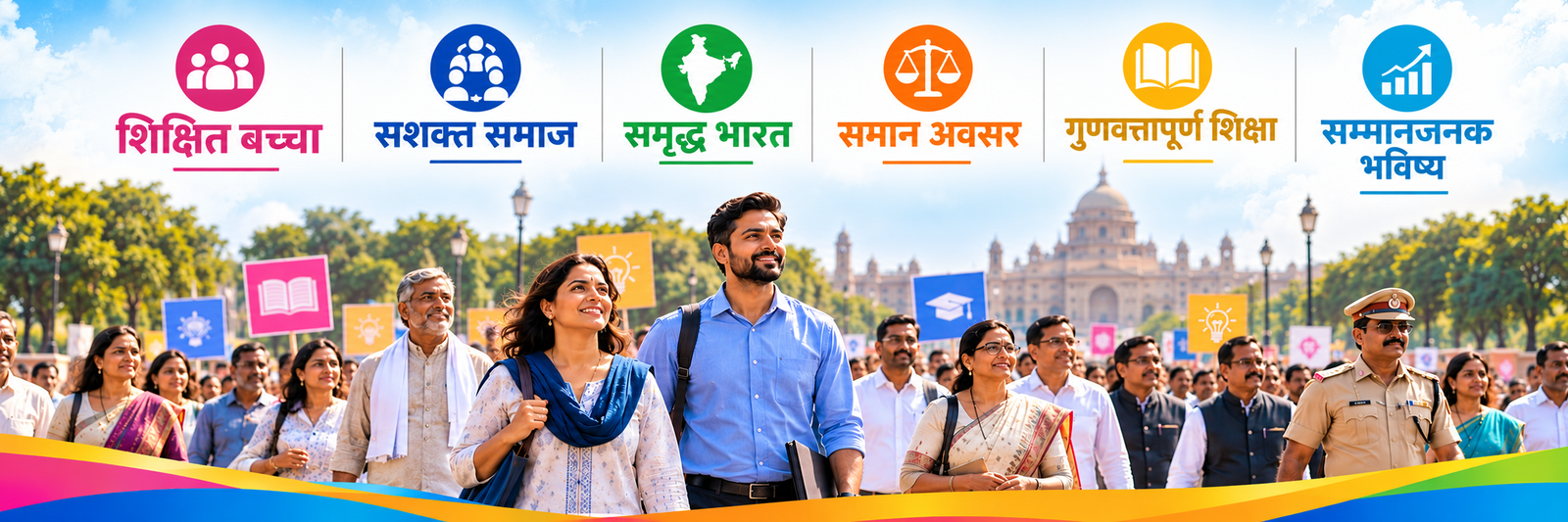
Every Child’s Potential Is India’s Potential
Why Equal Education is a Work of Nation-Building
Every child is born with possibilities. One may be born in an affluent urban family and another in a poor rural household. One may have highly educated parents, while another may have parents who never had the opportunity to attend school. One may grow up surrounded by books, computers, guidance and opportunities; another may have none of these. These circumstances are accidents of birth. They should not decide the quality of education a child receives or the future that becomes possible for that child.
Yet, educational opportunities remain deeply unequal. Some children study in schools with good infrastructure, adequate teachers, technology, libraries, sports, exposure and guidance. Many others study without even some of the basic facilities necessary for good learning.
The consequence is much larger than poor schooling. When a child does not receive the education required to develop her abilities, we lose human potential. And when this happens to millions of children, we lose a significant part of India’s potential.
Education is the Great Enabler
Every child has potential, but potential does not develop automatically. Education enables children to discover their abilities, acquire knowledge and skills, develop confidence, think independently and understand the opportunities available to them.
For children without inherited economic or social advantages, education is often the most powerful pathway to a better life. When the quality of education is unequal, opportunities also become unequal. Talent remains undiscovered, aspirations remain unrealised and human potential is lost.
Development, ultimately, is about people. A country may build roads, industries, institutions and technology, but its greatest resource remains the knowledge, capabilities, creativity, values and enterprise of its people. India’s future scientists may today be sitting in village schools. Its future doctors, teachers, engineers, entrepreneurs, artists, administrators, sportspersons and innovators may be children whose abilities are yet to be discovered. If they never receive the education required to develop those abilities, the loss is not theirs alone. It is India’s loss.
India can realise its full potential only when every child has a fair opportunity to realise hers or his. Equal and good-quality education is therefore not merely an educational objective. It is nation-building.
What Does Every Child Deserve?
Every child deserves a school with essential facilities, sufficient classrooms and trained teachers; functional toilets and safe drinking water; libraries and learning material; regular and effective teaching; sports and recreation; exposure to the wider world and career guidance. Education should also help children develop humanistic values, confidence, curiosity and responsible citizenship. Most importantly, every child should receive the support necessary to develop her or his potential. They are essential elements of good-quality education.
The question before us, therefore, should not only be: “What is wrong with our schools?”
A more useful question is: “What can all of us do to make every school better?”
Teachers, students, parents, School Management Committees, neighbourhood communities, citizens, administration and government are all stakeholders in education. Government certainly has major responsibilities, and these responsibilities must be fulfilled. But government alone cannot create a good school. Each stakeholder has a role, and sustainable improvement requires these roles to come together around one common purpose—the child.
From Finding Faults to Finding Solutions
Public concern about the condition of government schools is welcome. When citizens, media and public organisations raise issues of inadequate facilities, teacher shortages, learning outcomes and inequality, an important national issue receives the attention it deserves.
But identifying a problem is only the beginning. The real test is whether we can solve it.
It is easy to ask: Who is responsible?
It is harder, but far more useful, to ask: What needs to be done? Who can do it? And how can we work together to get it done?
A school is an ecosystem. Government provides policy, finance and institutional support. Administration converts these into implementation. Teachers make education happen in classrooms. Parents ensure attendance, encouragement and support. School Management Committees connect schools with communities. Citizens can contribute participation, resources, oversight and support. Civil society and professionals can bring expertise and public voice. Media can highlight deficiencies as well as improvements.
No single stakeholder can create a good school alone.
This understanding is at the heart of the Equal Education Campaign, a people’s effort to ensure equal and good-quality education, facilities and opportunities for every child.
A Different Approach to Public Action
Genuine deficiencies in schools must be identified, and governments must be held to their responsibilities. But when an effort becomes centred mainly on fault-finding, accusation and confrontation, stakeholders can become defensive. Teachers may feel targeted, officials may perceive hostility and cooperation—the very thing required to improve schools—can become more difficult.
Equal Education therefore follows a different route.
Identify problems without humiliating people. Demand what children are entitled to without turning every interaction into confrontation. Recognise good work while honestly documenting deficiencies. Fix locally what can be fixed locally. Take matters requiring government intervention to the appropriate authorities. Follow them up until action happens.
Above all, bring everyone back to the common objective—the child.
The approach is neither silence nor confrontation. It is constructive public action.
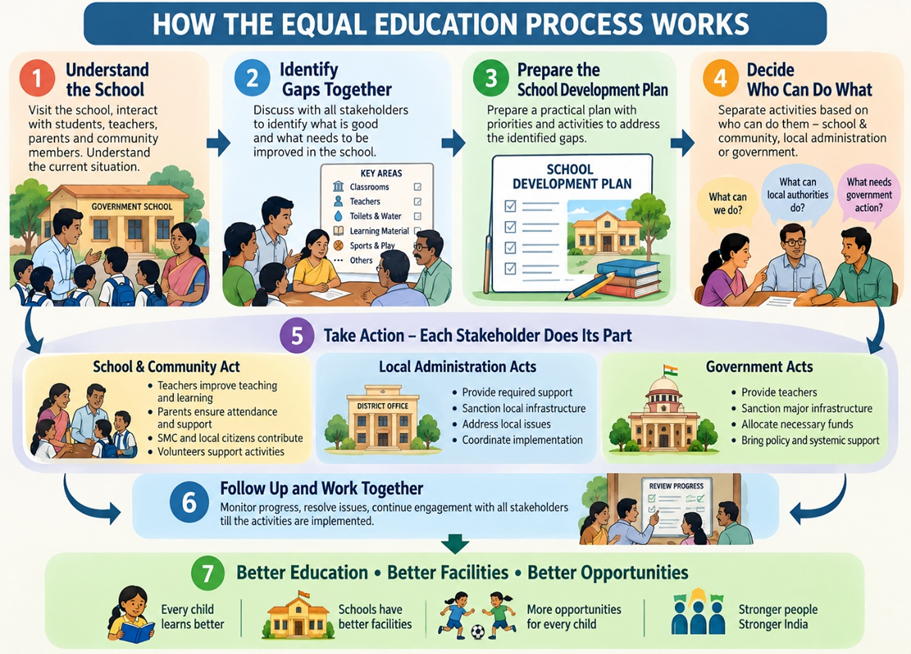
From a School Problem to a School Development Plan
Equal Education Volunteers work with teachers, parents, School Management Committees and neighbourhood communities to understand what a school requires for good-quality education. The gaps are identified and incorporated into a School Development Plan.
The next question is simple: Who can do what?
Activities that can be undertaken by teachers, parents, the SMC, community and volunteers are taken up locally. Matters requiring action by local bodies or district authorities are taken to them. Requirements involving teachers, major infrastructure, finance, policy or government sanction are placed before the appropriate government authorities.
Instead of everybody waiting for somebody else, each stakeholder is encouraged to fulfil her or his responsibility. Progress is followed up, improvements are documented and engagement continues.
Every Citizen Can Contribute
One does not need to be an education expert to contribute.
Teachers and educators can bring their experience. Parents can strengthen attendance and learning support. College students can mentor children and support libraries, sports and career exposure. Doctors can contribute to health and wellbeing. Engineers can assist with water, sanitation, electricity, buildings and safety. Journalists can keep education in public consciousness. NGOs and professional associations can contribute expertise and networks. Senior citizens can offer time, experience and guidance.
And ordinary citizens can begin simply by taking an interest in the government school in their own neighbourhood. The Equal Education Campaign does not seek to stand outside the system and merely point towards its shortcomings. It seeks to bring people together to improve it.
The journey from a child’s potential to India’s potential is straightforward. Good education develops capabilities. Capabilities create opportunities. Opportunities enable people to realise their potential. Capable and responsible citizens strengthen society and the economy. And a stronger society enables the nation to realise its potential.
Every child we fail to educate well represents potential that may never be realised. Every child whom we enable to learn, grow and flourish adds to the strength of the country.
Every child’s potential is India’s potential.Equal Education — Equal Opportunity — Better Future
Samaan Shekhar
Coordinator
Samaan Shiksha Jansamiti
