


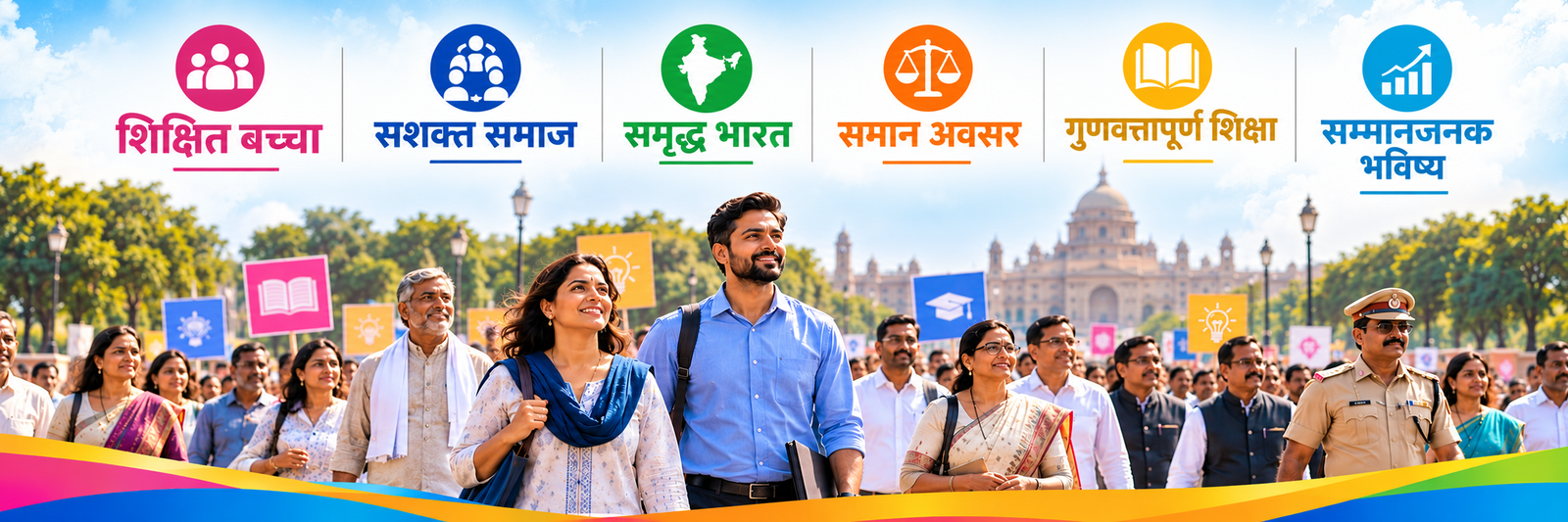
Let Opportunities Open with Schools
Every July, a familiar scene unfolds across urban and semi-urban India. Bookstores are crowded, school buses return to the roads, new uniforms are ironed, school bags are packed, and dinner-table conversations revolve around timetables, textbooks and the new academic session. There is excitement in the air—especially among parents who have managed to secure admission for their children in private schools, often at a financial cost far beyond what they can afford. They see quality education as the most valuable investment they can make, believing that it will multiply their children’s opportunities and prosperity.
A very different picture emerges in government schools.
Their reopening is marked by little excitement and even less expectation. Parents arrive with subdued hope, children return without great anticipation, and teachers struggle in the July heat to ensure sufficient enrolment for their schools. Many worry that declining admissions may eventually lead to transfers or even closure of schools. For countless parents, government schools no longer represent a pathway out of poverty. Instead, they have become symbols of limited opportunity.
Somewhere along the way, we have quietly accepted a dangerous idea—that education is merely another commodity. Like products displayed in a marketplace, schools are perceived as being available in different qualities, each carrying a different price tag. Better facilities, better teachers, better exposure and better opportunities are increasingly seen as things that must be purchased. Those who can pay receive more; those who cannot must settle for less.
What is even more worrying is that this idea has become normalized—not only by those who profit from the commercialization of education, but also by those who suffer its consequences. As a result, two Indias are growing side by side, looking at education through entirely different lenses and preparing children for two vastly different futures. Nothing could be more alarming for a country like India.
Our greatest national resource is neither our minerals nor our industries; it is our people—and, above all, our children. Yet, when a majority of them are denied even basic educational facilities and quality learning, we are effectively limiting the nation’s future. According to the ASER 2024 Report, 66.8 per cent of India’s school-going (6-14 years) children study in government schools. If these children do not receive quality education, we are rendering a majority of our next generation incapable of contributing to national development according to their true potential.
India often speaks of reaping the demographic dividend. But a demographic dividend is not an automatic outcome of having a young population. It can only be realised by building the capacities of that population. And there is no more powerful instrument for building those capacities than providing every child—irrespective of family background, income or location—with good quality education.
The obvious question then arises: why are we not doing it?
Is the government unaware of this challenge? Or does it know the problem but fail to address it effectively? Is civil society unaware? These are uncomfortable but necessary questions because one fact is impossible to ignore—hardly anyone is talking about this crisis.
A quick look at our print and electronic media reveals the irony. Television debates spend hours discussing issues of fleeting political/religious significance, while the poor state of government schools rarely becomes national news. Newspapers routinely report sensational events but seldom treat educational inequality as the national emergency that it truly is. Problems that do not occupy public discourse rarely occupy public policy.
Can this situation change?
Can government schools become places where children from poor and disadvantaged families discover hope instead of helplessness? The answer depends upon the willingness of every stakeholder in education—the government, teachers, parents, students and the community.
Among these stakeholders, one has remained the least recognised but perhaps holds the greatest transformative potential: the community. For decades, communities remained largely outside the management of schools. Today, however, they are expected to occupy centre stage. The recently issued School Management Committee Guidelines envisage a far greater role for communities in the governance and development of neighbourhood schools.
This is not an untested idea. Several countries with outstanding public education systems have successfully built community participation into school governance. Norway’s Cooperation Committees, Japan’s School Management Councils and China’s Neighbourhood Committees have all demonstrated how meaningful community participation can strengthen schools and improve educational outcomes.
India, unfortunately, tells a different story.
More than sixteen years have passed since the Right to Education Act, 2009 gave legal recognition to School Management Committees (SMCs). Yet, in thousands of schools, SMCs exist only on paper. Many parents do not even know that they are members of these committees. Meetings are frequently recorded on paper without actually taking place. Genuine community participation remains the exception rather than the rule.
Why has this happened? There are several reasons. First, many teachers and school staff remain reluctant to involve parents and community members in school management. Instead of viewing them as partners, they often perceive them as unnecessary interference. Second, the parents who constitute the core of SMCs largely belong to poor and disadvantaged families. Many are unaware of both their rights and their responsibilities under the law. Third, neighbourhood communities themselves have not yet recognised that improving their local government school is also their responsibility.
Although governments have enacted laws and issued guidelines, they remain ill-equipped to ensure meaningful participation by teachers, parents and communities. When compliance is demanded, fake meeting records often become an easy substitute for genuine participation. There is little institutional mechanism to educate parents and community members about their role in school governance. Consequently, SMCs remain trapped in a vicious cycle of low awareness and low willingness.
Yet this vicious cycle is not irreversible. Like the countries that have successfully transformed their public education systems, India too can revitalise its schools by making School Management Committees truly functional. What is required is not merely another government order but a community/social initiative that builds trust, awareness and cooperation among teachers, parents, community, government and administration.
Teachers must begin to see SMCs as allies rather than adversaries. Parents must become aware of both their rights and their responsibilities. Communities must recognise that the quality of their neighbourhood school is inseparable from the future of their own children and society.
Someone has to bridge these gaps. Recognising this need, Dignified India launched the Equal Education Campaignin 2025. The organisation has resolved to build a nationwide network of Equal Education Volunteers who work not as critics of the system but as facilitators of cooperation among all stakeholders in school education.
Extensive training programmes have been developed to equip volunteers with a thorough understanding of School Management Committees, school development planning, relevant legal provisions and practical methods of community mobilisation. These volunteers are reaching out to people in their neighbourhoods, encouraging them to become active participants in improving their neighbourhood government schools. They engage with teachers, parents and community members, creating awareness about their respective roles and motivating them to work together for the future of their children.
Far from replacing the efforts of governments or school administrations, this initiative seeks to complement them. It aims to strengthen existing institutions by making community participation real rather than symbolic. We are confident that the sincere efforts of our volunteers will result in better facilities, improved learning environments and stronger community ownership—not only in the schools directly covered under the Equal Education Campaign, but eventually across districts and states.
Social change spreads gradually. One successful school inspires another. One active community encourages the next. A movement that begins in a neighbourhood can ultimately reshape a nation. When that happens, government schools will no longer reopen each July amidst anxiety and diminished expectations. They will reopen as centres of hope, dignity and opportunity. Their gates will no longer merely admit children into classrooms; they will open pathways to a better future.
And when opportunities begin opening with schools, India itself will begin opening to its fullest potential.
Samaan Shekhar
Coordinator
Samaan Shiksha Jansamiti
